
World’s biggest brands increasingly spend less of their sales revenue on advertising – except consumer goods giants
| Ad-to-sales ratio among top 25 US advertisers drops from 6.1% in 2019 to 5.5% in 2025 Big tech companies are driving the downward trend Consumer goods brands are an outlier on average growing ad spend 36% against revenue growth of 29% “WARC Media’s Global Ad Trends – The cost of being seen” examines the shifts in advertising intensity among 25 of the world’s largest brands |
| 15 October 2026 – The world’s largest brand owners are, on average, spending a diminishing share of their sales revenue on advertising – with the notable exception of consumer goods companies, finds WARC Media. |

In its latest “Global Ad Trends report: The cost of being seen”, WARC Media examines shifts in advertising intensity among 25 of the world’s largest advertisers, to better understand the extent to which big brand-owners are driving growth in the global market.
Alex Brownsell, Head of Content, WARC Media, says: “The global ad market is expanding rapidly, but companies from Meta to Mastercard and McDonald’s are allocating a diminishing share of revenue to advertising. Only consumer goods companies – buffeted by softening sales growth and with trade budgets moving into measured media – are increasing ad intensity.
“This underlines what we’ve previously reported – namely that we are operating in a two-speed marketplace. The expansion of digital platform spend by smaller businesses and cross-border e-commerce sellers is by far outpacing growth in ad investment by big brands. This has major implications for the ecosystem of agencies and vendors operating in the enterprise market.”
Key findings outlined in WARC’s “Global Ad Trends: The cost of being seen” are:
Advertising intensity is changing
WARC Media forecasts global ad spend to grow 11.9% this year to $1.34trn. Adjusted for inflation, this is an increase of 61.3% over the last 25 years, fuelled by new channels like retail media and platform advertising that didn’t exist a decade ago.
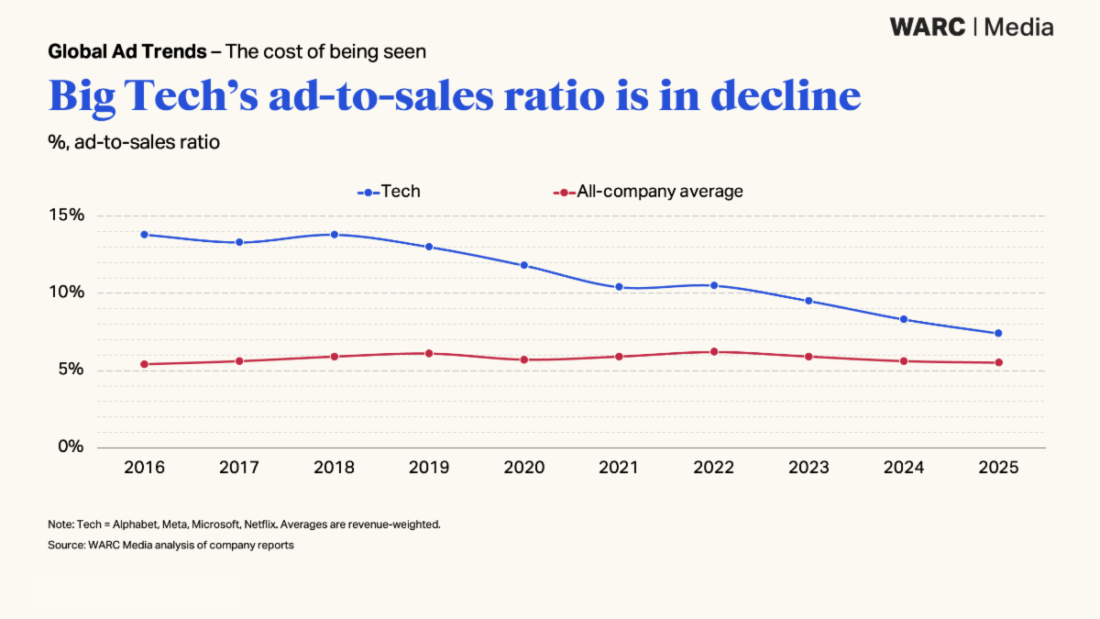
However, advertising intensity has declined in recent years. Across 25 large US-based advertisers, the combined ad-to-sales ratio, a measure of how much companies spend relative to their size, fell from 6.1% in 2019 to 5.5% in 2025. This does not represent a retreat from advertising: their combined ad spend rose 56%, but budgets have not kept pace with rising revenue, which rose by 73%.
Big Tech companies are driving the downward trend
Alphabet, Meta, Microsoft and Netflix’s combined ad-to-sales ratio fell from 13.0% to 7.4% between 2019 and 2025, while their combined revenue rose 146%, from $379bn to $931bn. Had they maintained their 2019 ratio, these brands would have spent $121bn in 2025 – $52bn more than they actually did.
Consumer goods brands are an outlier, with intensity rising
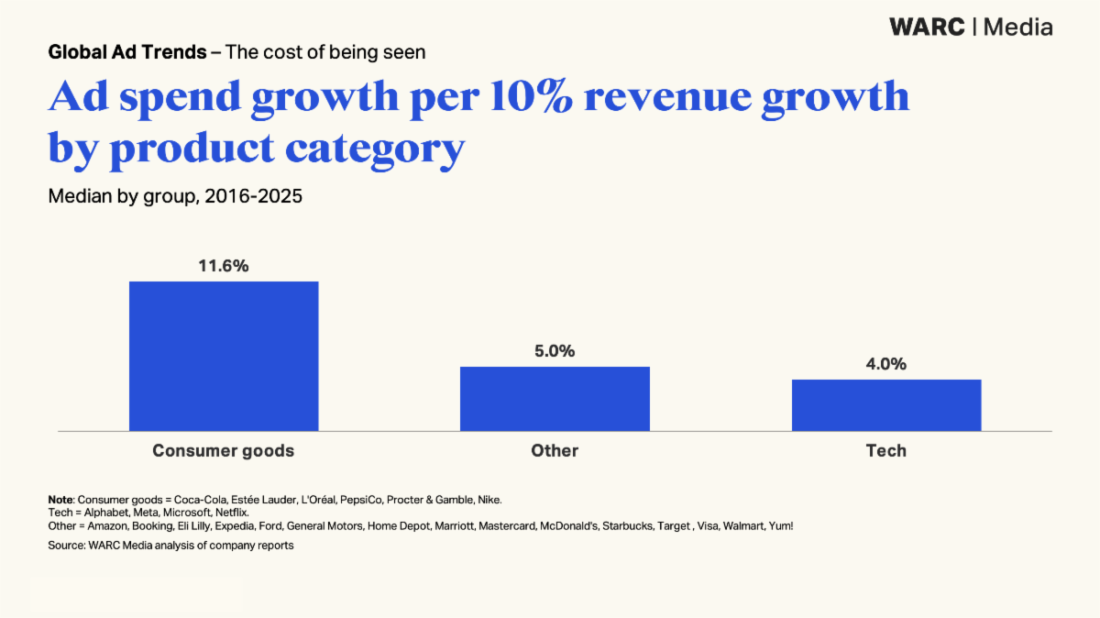
The six biggest consumer goods brands analysed by WARC Media – Coca-Cola, Estée Lauder, L’Oréal, Nike, PepsiCo and Procter & Gamble – moved the other way. Five raised their ad-to-sales ratios between 2019 and 2025; PepsiCo’s was broadly flat.
Softening sales growth pushed the combined consumer goods ad-to-sales ratio from 11.6% in 2023 to 12.5% in 2025, with budget shifts into areas like retail media further lifting ad intensity. From 2019 to 2025, their collective ad spend grew 36%, outpacing 29% revenue growth.
Non tech companies and consumer goods brands are less consistent
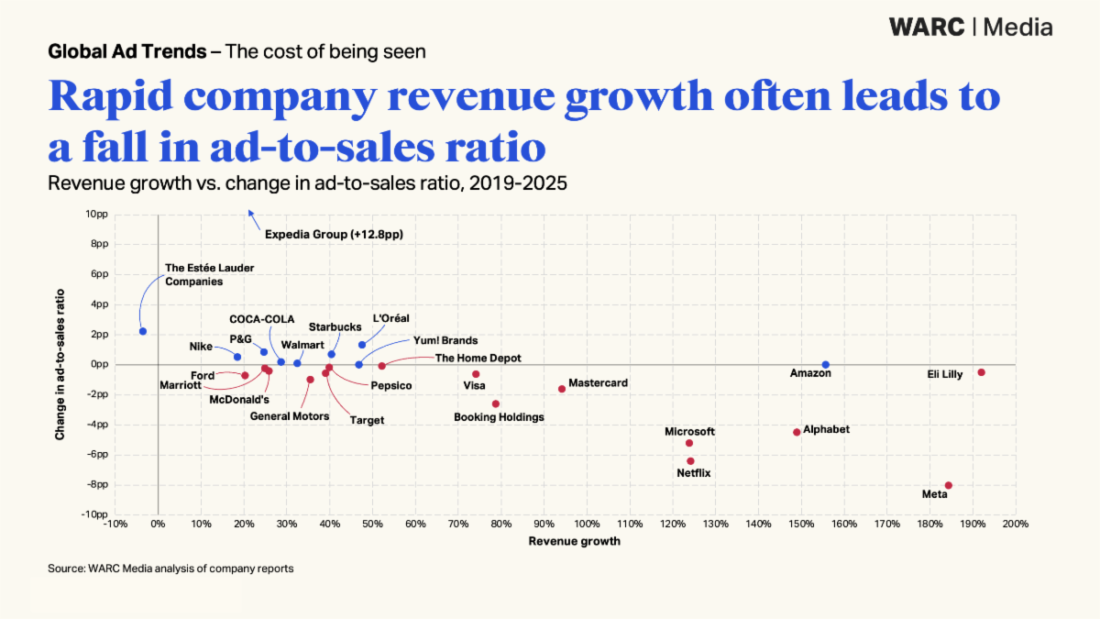
The remaining 15 advertisers – neither tech nor consumer goods – tell a less consistent story. Weighted by revenue, the group’s average ratio was flat to slightly up, yet 10 of the 15 individual companies cut their ratios between 2019 and 2025:
- Automotive: Ford (2.3% to 1.6%) and General Motors (2.7% to 1.7%).
- Payments: Visa (4.8% to 4.2%) and Mastercard (5.6% to 4.0%).
- Restaurants and retail: McDonald’s (1.7% to 1.3%) and Target (2.0% to 1.4%).
- Also falling: Marriott, Booking Holdings, Eli Lilly and The Home Depot.
- Amazon and Yum! Brands were broadly flat.
- Three companies saw their ad-to-sales ratios rise: Walmart, Starbucks and Expedia.
The three forces behind the ratio split
There are three main forces that cause changes to ad intensity:
- Weak sales. Brands maintaining ad spend in adverse market conditions, with sales going into reverse, may see ad intensity rise.
- Budgets changing lines. Money that used to sit with sales teams as trade and shopper spend is moving into retail media, and so into the advertising line.
- Owning versus renting attention. Companies that own an audience, like Alphabet and Meta, have an opportunity to grow without renting attention.
WARC Media subscribers can read the report in full. A WARC podcast on the findings outlined in the report will be available from 17 November.
Global Ad Trends, part of WARC Media, is a quarterly report which draws on WARC’s dataset of advertising and media intelligence to take a holistic view on current industry developments.