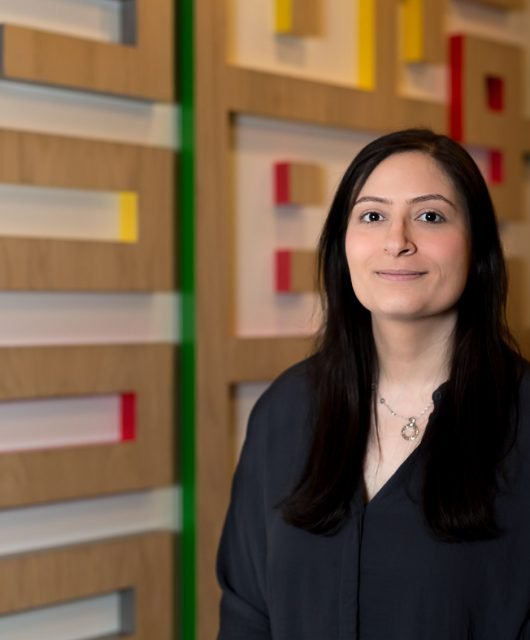
The Wonder Women of MENA: Google’s Leen Fakhreddin
The Alpha Illusion: Why We Must Rewrite the Architecture of Leadership

We have long been conditioned to recognize power by its volume. For decades, the corporate boardroom was built in the image of the loud, authoritarian alpha. Today, that archetype has quieted. But while the temperament has changed, the underlying architecture remains the same: a system coded by and for a highly specific type of man.
When the rooms where our collective future is drafted are built on a monoculture, we get skewed realities and fractured workplace cultures.
Over a two-decade career—spanning agencies in Jordan and Dubai to other roles at Meta, Visa, and now Google—I have navigated a pipeline explicitly designed to leak women. I survived those early-career hurdles. Today, as I prepare to send my daughter to university, I am acutely aware that I beat a system built for someone else.
But the battles do not end at the executive level; they simply turn inward.
It is a well-documented double bind: a man driving aggressive growth is lauded as a visionary, while a woman executing the exact same strategy is penalized for being abrasive. Yet, the most insidious consequence of this male-dominated architecture is not just how men treat women, but what it conditions women to do to each other.
The friction often comes from within. We carry generations of cultural conditioning into the office—a deeply ingrained mentality that subconsciously defaults to the man as the ultimate authority.
Consequently, even in the most progressive corporate environments, we witness a startling paradox: some women remain subservient to male leadership. We extend grace to average men, yet withhold that same respect from equally, if not better, qualified women. The territorialism we experience is not just the result of artificial scarcity or competing for a singular “female slot” at the table. It is the friction of women subconsciously resisting the disruption of an ancient cultural hierarchy. If we are to demand equal executive power, we must take absolute accountability for the patriarchal conditioning we enforce against our own.
I have felt the sting of this internalized territorialism firsthand, but I refuse to accept it as the cost of doing business. My own ascent was secured by women who actively recognized and rejected this conditioning. From the managing director who went out of her way to champion my first major role in Dubai, to the network of advocates who guided my transitions through Meta, to the phenomenal mentors I’ve relied on throughout my career—these women are proof that pulling someone else up is a competitive advantage. This is how I interpret “Give to Gain”—it is not corporate charity. It is an active rebellion, and the ultimate strategy for sustainable growth.
Fostering this requires us to abandon the myth of the lone corporate genius. In high-stakes, fast-moving environments, individual brilliance frays without a baseline of operational trust. My mandate as a leader is to relentlessly fight for my team and enforce the radical honesty required to sustain that trust.
This is not an exercise in corporate empathy; it is a business imperative. By championing this culture, teams do not just report higher engagement scores—they move faster, take the necessary risks to drive innovation, and deliver measurable impact without the drag of internal warfare.
The next generation of women in this industry must reject the traditional archetype entirely, and never apologize for their ambition.
Do not fall into the trap of guarding your territory or policing the women around you. Refuse to carry the baggage of a culture that asks you to defer to men while diminishing your peers. Secure your power, reach back to pull another woman up, and stop fighting for a single seat at a fundamentally flawed table. It is time to build a better one.