Global Consumer Agentic AI Spending Will Soar To $3.35trn In 2030
3.8% of global consumer spending will be agent-facilitated in 2030, tripling from this year’s 1.3% equivalent to $944bn Top ten global markets will account for two-thirds (67.9%) of the global consumer agentic AI spend in 2030 US share of global agentic AI spend in 2030 will reach 31.9% Telecoms & utilities, financial services and travel & transport will lead agent-to-agent transactions New WARC x PHD research: From abundance to agents – how the delegation of choice is transforming marketing. Introducing the Four Modes Framework |
21 July 2026 – Marketing is operating in an age of abundance. Today’s consumers face more content and choices than they have the attention or means to manage. AI agents are emerging as fundamental tools to help consumers cut through the noise and make decisions faster. New research by PHD in partnership with WARC reveals how quickly they are reshaping the customer journey.
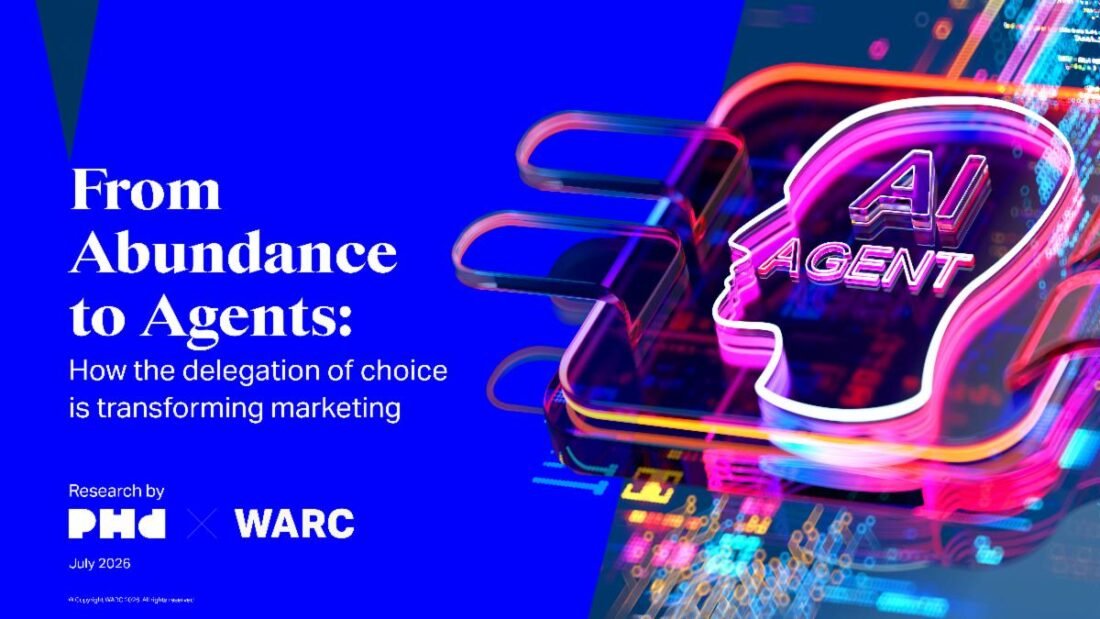
The study finds that total agent-facilitated consumer spending will triple from $944bn this year to $3.35trn in 2030. While consumers will still make most purchase decisions on their own in the next few years, AI agents will increasingly shape what gets seen, shortlisted and bought – and will increasingly mediate the boring, complex or repetitive tasks along the way.
As decision-making increasingly evolves from human consumers to machine intermediaries, this study explores the scale, timeline and implications for brands, agencies and the wider marketing ecosystem.
Rohan Tambyrajah, Worldwide Chief Strategy Officer, PHD, says: “This research brings category level empiricism to the open-ended industry conversation about the growth opportunity with consumer facing AI and Agentic AI. It underscores the need for brands to design for both meaning and machine logic, and through Four Modes Framework offers marketers practical guidance on how best to implement against a category-level business case.”
James McDonald, Director of Data, Intelligence & Forecasting, WARC, and author of the research, says: “This landmark study finds that agentic AI is already facilitating the path to purchase for many consumers, and will become deeply embedded over the coming years to influence $3.35trn in household expenditure by 2030.
“This is true not just in high-frequency categories such as travel, CPG, and utilities, but increasingly more so in sectors that have traditionally leveraged brand marketing as a core strategy. By mapping adoption across product sectors, markets and media, our research ensures practitioners are not caught flat-footed as they approach the new frontier.”
Methodology of the research
The research draws on data provided by Acxiom and uses a weighted index approach to evaluate key factors such as decision complexity, transaction value, purchase frequency, data availability, media mix, and market regulation to make a holistic assessment of how much consumers will spend on AI channels in 2026 and 2030. The analysis covers the global viewpoint of ten markets: Australia, Brazil, China, France, Germany, India, Mexico, South Korea, UK & US. Additionally, it includes industry expert views and category analysis.
Key findings from the research outlined in ‘From abundance to agents – how the delegation of choice is transforming marketing’ are:
Categories and markets leading on agentic AI consumer spend
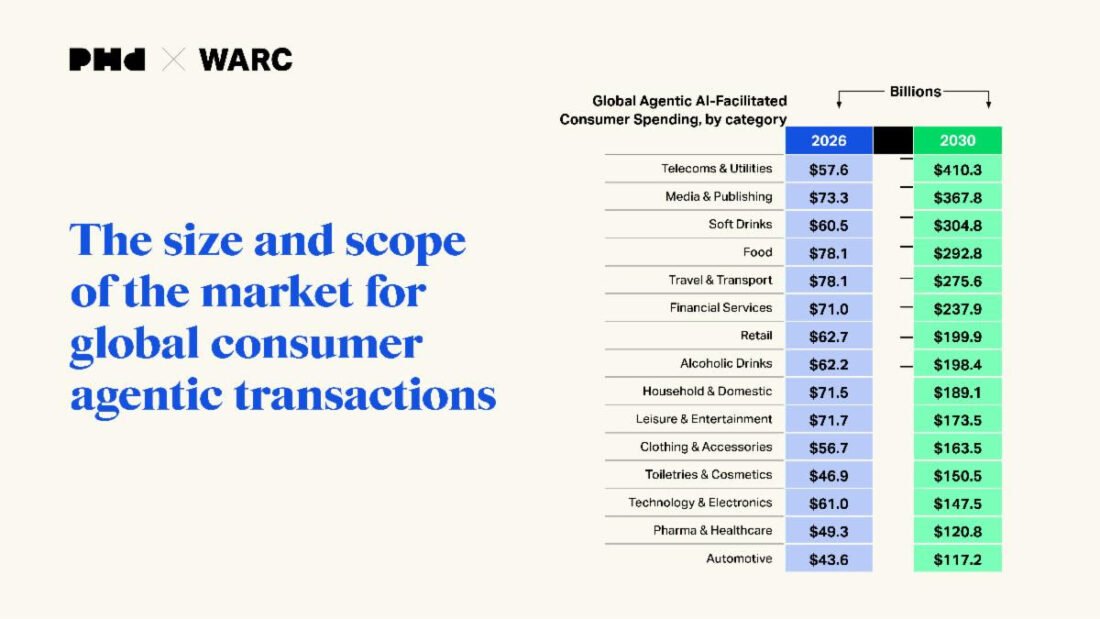
Agentic AI – artificial intelligence systems that understand goals, plans steps, and act autonomously – are making their mark on high-frequency categories like travel & transport, food, and media & publishing. By 2030, AI-facilitated spending will surge across all industries, especially where purchases are frequent and data-rich.
The top three markets for agentic AI consumer spending in 2030 will be:
US: The US will lead agentic AI spending at $1.1trn (31.9% of the global total), driven by consumers already comfortable with digital commerce and brands with the resources to deploy agents at scale.
China: China will be the second-largest market at $505.8bn (15.1% of global spend), powered by high platform integration, government support, and consumers ready to embrace delegated commerce.
UK: The UK will capture 3.9% of global agentic AI spending ($131.2bn), driven by strong talent, major investments, and government backing for AI-led transformation.
How agentic AI will affect consumer spending: introducing The Four Modes Framework
Agentic AI will not impact all industry categories evenly. PHD’s Four Modes Framework defines where marketing must evolve as brands extend focus to influencing machines. Each mode of marketing requires strategy, capability design and creativity—and all four will coexist, with their importance varying by category, purchase occasion and customer journey stage. The framework serves as a navigation tool to see the category impact of agentic AI on marginal purchasing decisions in 2026 and 2030, while recognising that brand advertising, salience, and equity remain fundamental to success.
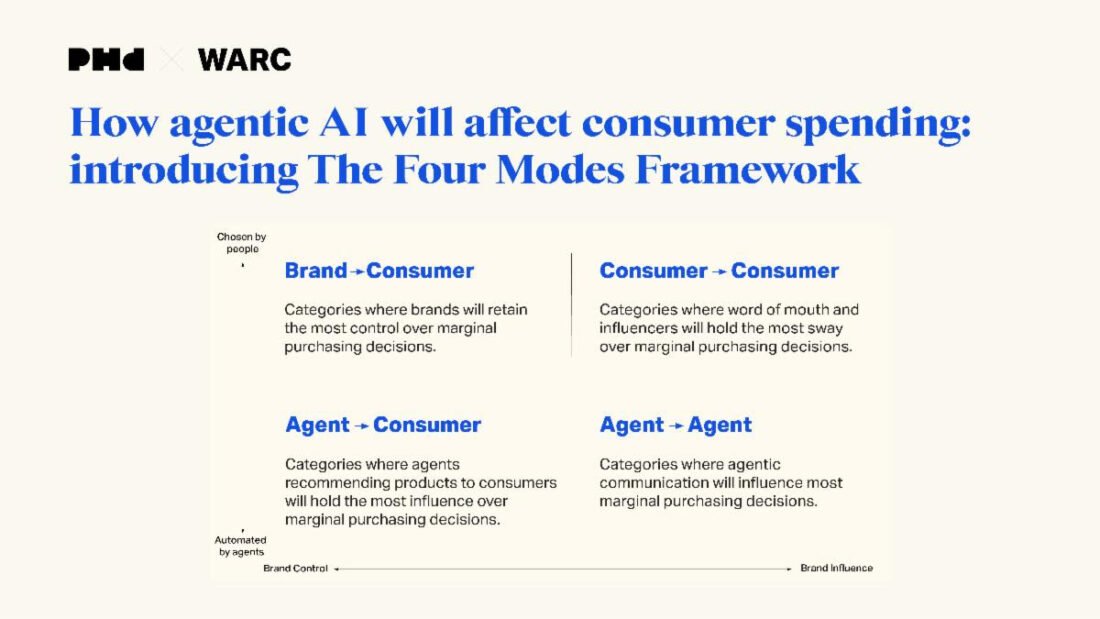
Agent → Agent:
Agent adoption will surge where purchases are repetitive, searchable, and measurable—not necessarily high-volume or low-value, just routine enough for AI to own the entire journey.
The three industry categories where agentic AI will have the greatest impact are:
1. Telecoms & Utilities will grow 611.9% from $57.6bn in 2026 to $410.3bn by 2030 – making it the largest category for AI agents. Information-dense, frequent billing, and comparison-led contract switching make these infrequent but high-value purchases ideal for AI delegation.
2. Financial Services decisions are too sensitive to fully delegate, but too complex not to be agent-assisted. Total agent-facilitated consumer spending will increase 235.3% to $237.9bn by 2030.
3. Travel & Transport will lead agent-facilitated spending at $78.1bn in 2026, surging 252.8% to $275.6bn by 2030 as AI agents take control of discovery, planning, and booking.
Agent → Consumer:
1. Alcoholic Drinks: This category is habitual and identity-driven – brand loyalty still rules. AI agents will influence $62bn in spending in 2026, advising on party ideas, drink pairings, and occasions. By 2030, agentic spending will grow 219.0% to $198.4bn as agents dominate both replenishment and discovery.
Soft Drinks: Starting small at $60.5bn in agent-influenced spending in 2026, it will see massive growth of 403.5% to $304.8bn by 2030. Habit-driven, low-value replenishment is perfect for AI automation—optimising price, convenience, and repeat purchasing.
2. Food: This category is primed for early use of agentic AI thanks to is high frequency, low decision complexity. Agents will influence $78.1bn globally in 2026, surging 274.8% to $292.8bn by 2030.
3. Media & Publishing: At $73.3bn, this category is already one of the most impacted by agentic AI. Subscriptions, recommendations, and content consumption are digitally native and measurable. By 2030, agentic AI spending will increase 401.8% to $367.8bn.
4. Retail: will see agent-facilitated spending grow 218.7%—from $62.7bn in 2026 to $199.9bn in 2030 driven by omnichannel shopping and AI comparison. The challenge for retailers will be to remain part of the consumer shopping journey, not just a fulfillment provider.
Brand → Consumer
High-value, infrequent purchases such as automobiles, electronics, and categories with privacy constraints such as pharma & healthcare, leave less room for agentic AI transaction. Trust is important as consumers must feel confident before delegating expensive or privacy-sensitive decisions.
Consumer → Consumer
Categories such as toiletries & cosmetics, clothing & accessories are heavily influenced by word of mouth and creators and are less affected by agentic AI than others. The impact may be smaller, but it won’t be completely absent.
The brand imperative
Brands must learn new skills to successfully market to machines. The shift to agentic AI will require marketers to have:
- A strong foundation of structured, machine-readable data
- Distinctive and differentiated brand assets
- A unified brand story that resonates with both humans and AI interfaces
‘From abundance to agents – how the delegation of choice is transforming marketing’ report is available to read in full here.