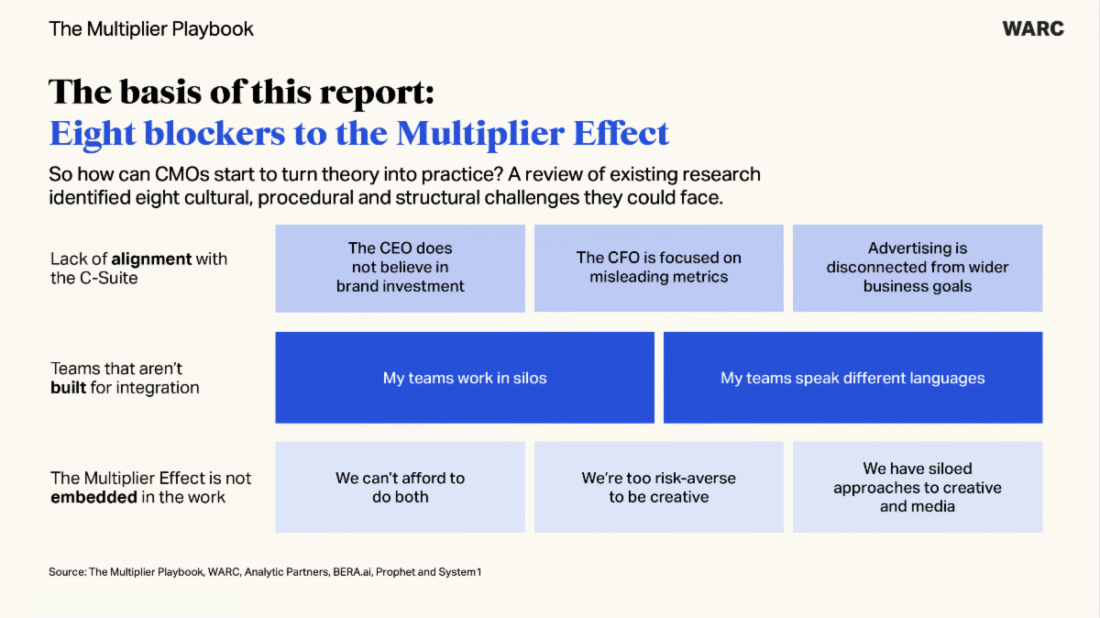
Eight major blockers prevent CMOs from closing the gap between brand and performance advertising to drive greater impact
| 90% of ads are not given time to “wear in” and achieve their full impact 60% of marketers say the role of advertising is not fully understood by the C-Suite 49% of organizations have siloed brand and performance teams, hindering integration Only 21% of marketers report advertising objectives alignment with C-Suite WARC, in partnership with Analytic Partners, BERA.ai, Prophet and System1, release The Multiplier Playbook – The CMO’s guide to integrating brand and performance. The report incorporates a new survey of senior marketers with the ANA |
| May 19, 2026 – There is a “say-do gap” in advertising: most marketers know the theory of effectiveness, but struggle to apply it. WARC and a coalition of effectiveness experts have identified eight major blockers for marketers to overcome as they seek to close this gap. |
Spanning cultural, procedural and structural misalignments, these barriers undermine effective advertising by preventing marketers from implementing evidence-based principles, such as those demonstrated in the landmark study The Multiplier Effect, released last year.
From a disconnect between the CMO and the C-Suite on the role of brand-building, CEO and CFO confusion on the purpose of advertising investment in modern business, and entrenched silos within marketing teams, these blockers, and the plays needed to overcome them, are explored in The Multiplier Playbook, a new report released today, and a must-read for every marketer.
David Tiltman, Chief Content Officer, WARC, and SVP Content, LIONS Intelligence, says: “Since the launch of The Multiplier Effect study last year, it has become clear that the challenges facing marketers are not about knowing the theory. Most CMOs cannot simply change their strategic and investment approach wholesale without overcoming a number of hurdles.
“What is needed is a Playbook – a combination of data, frameworks and real-world examples that help marketers recognize the key “blockers” they might face – and give them some “plays” to help them take action and make progress. The Multiplier Playbook does just that.”
The Playbook combines data from a new survey of over 200 senior marketers conducted by WARC and the Association of National Advertisers (ANA) in the US between December 2025 and March 2026, with additional data, frameworks and insights from WARC and its partners in the Multiplier Effect:Analytic Partners, BERA.ai, Prophet and System1.
The eight blockers to the Multiplier Effect
Previously reported data for The Multiplier Effect report from Analytic Partners ROI Genome found that brands that shifted from performance-only to a mixed approach of brand and performance advertising saw a remarkable 90% median average uplift in revenue return on investment.
To implement this approach, marketers should review the eight cultural, procedural and structural challenges they could face enabling them to succeed in aligning with the C-Suite, integrating teams, and embedding the Multiplier Effect into the work.
Aligning with the C-Suite
The study confirms that alignment with the C-Suite is consistently cited as a barrier to investing in brand-building and unlocking the Multiplier Effect:
The brand disconnect
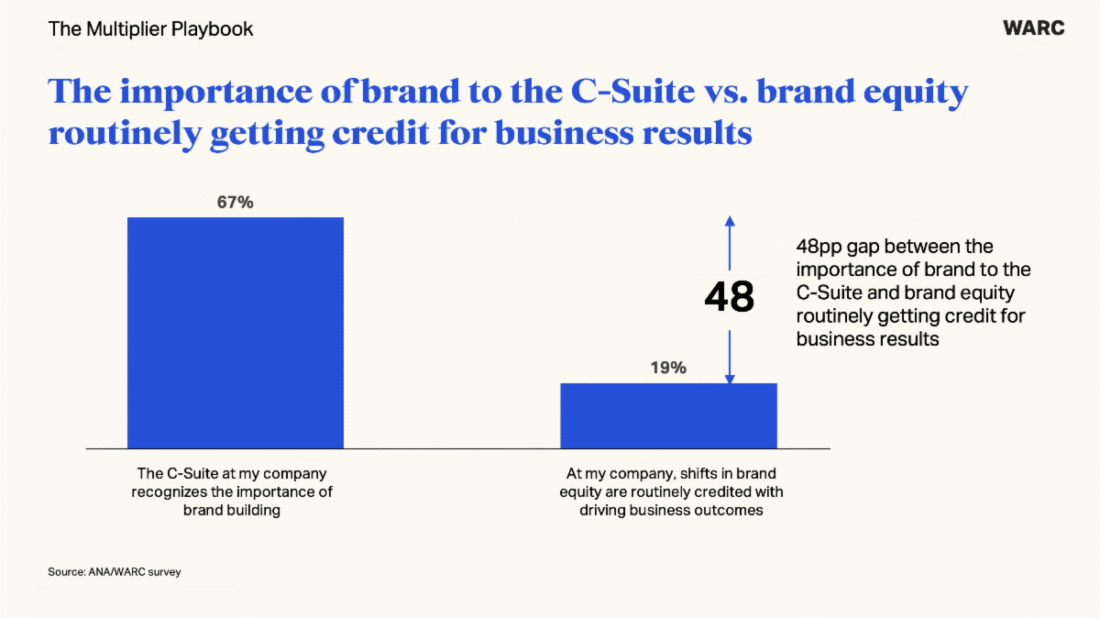
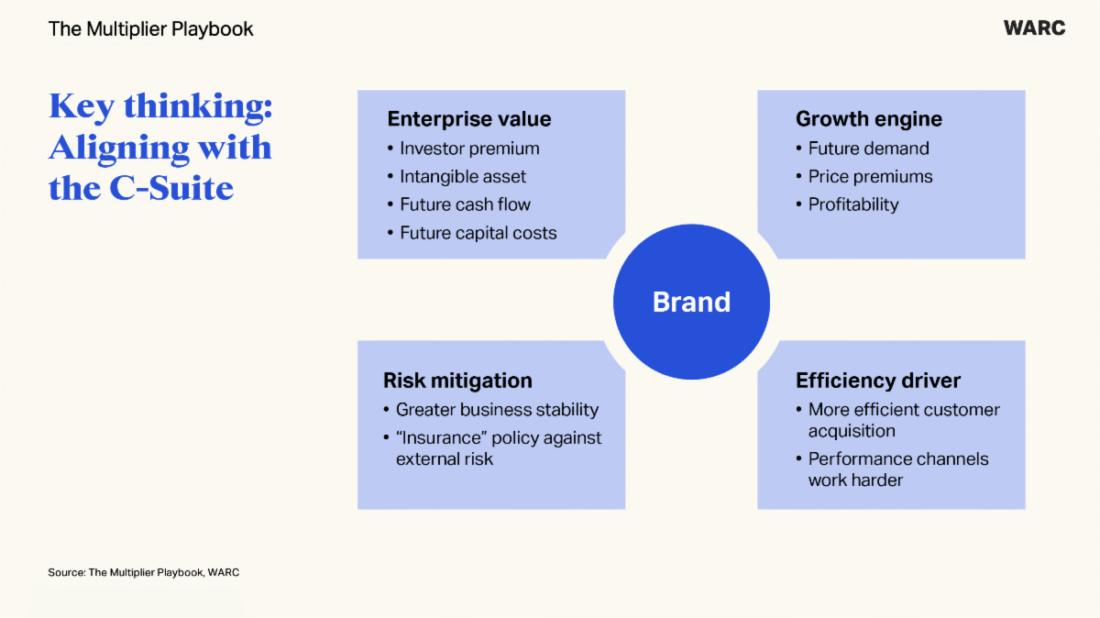
Approximately two-thirds (67%) of marketers agree that their CEO believes that brand is important. But only 19% of marketers said the C-Suite routinely makes the connection between shifts in brand equity and hard business outcomes.
In short, brand strength is not seen as driver of sales day-to-day.
| Marketers are advised to make a stronger case for brand-building to the CEO and CFO – but first they need to be clear about what problem(s) their company faces that a stronger brand would help solve. The report shares four ways to frame brand-building in this way, depending on corporate priorities. |
The advertising disconnect
The role of advertising in driving commercial objectives is also a major point of misalignment.
A majority (60%) of survey respondents felt that the C-Suite does not fully understand the role of advertising, and just one in five marketers (21%) strongly agreed their advertising objectives were aligned with C-Suite objectives.
The dominance of efficiency-based metrics such as platform- and channel-specific ROAS in modern advertising serves to deepen this division. The result, in many organizations, is a very narrow view of what advertising is there to achieve – making it a cost of sale, rather than an investment in value creation.
As shown by the results from the ANA/WARC survey, a reliance on short-term tactics and metrics only aligns with one of the C-Suite’s top five commercial priorities. Brand-building, by contrast, explicitly serves the other four – while also generating short-term sales and boosting the efficiency of performance advertising.
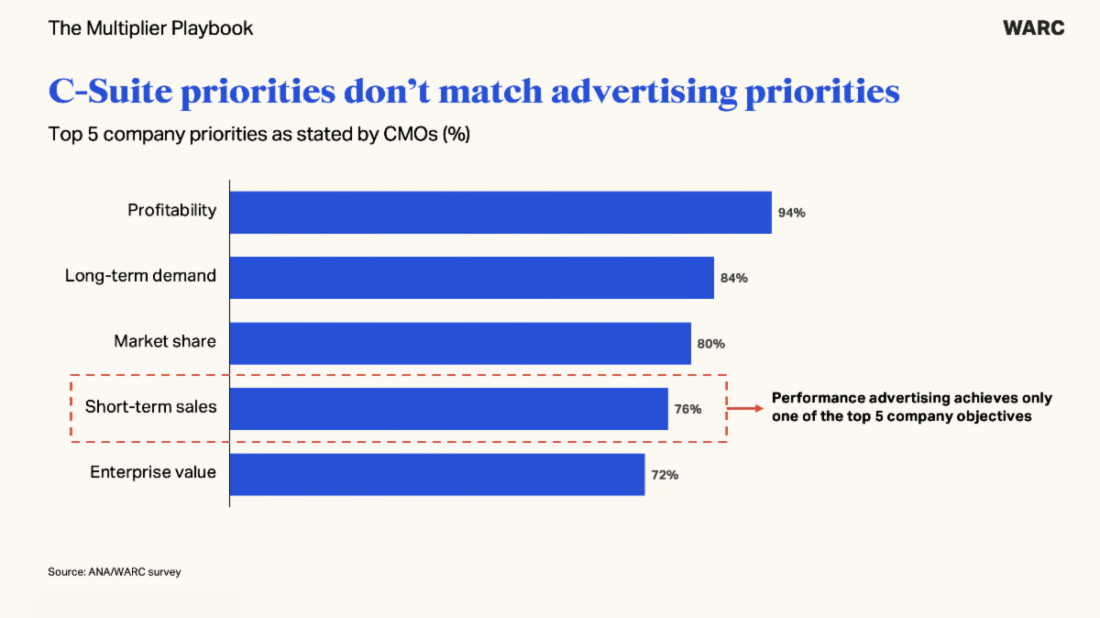
Marketers are advised to challenge a fixation with narrow channel-specific metrics like platform-specific ROAS and take steps to align advertising objectives with corporate goals.
Building integrated teams
Structural issues with the marketing department are also hindering implementation of best practices to achieve the Multiplier Effect. The emergence of brand and performance “silos” is making integrated thinking harder to achieve.
Responses to the ANA/WARC survey highlighted how brand and performance teams are struggling to work together in meaningful ways:
- half (49%) of organizations have separate brand and performance teams, compared with 25% that have fully integrated teams;
- 65% have separate brand and performance budgets;
- only 44% say they have a “common language” for their brand and performance teams;
- similarly, just 44% of brand and performance teams have a common understanding of which audiences are most likely to deliver growth.
While specialists will always be needed, marketing leaders should be looking for ways to drive collaboration between their teams. Marketers are advised to develop a shared vision of what success will look like that is rooted in customer behavior change, and to identify tentpole moments in the calendar that force integration between teams.
The report includes an example from Instacart, where Laura Jones, the company’s Chief Marketing Officer, has recommended looking to find moments to bring teams together: “We have to ‘make our own weather’. We have to create events and campaigns that are big where we can all row in that same direction and get more return out of all of our effort when it’s united.”
Embedding the Multiplier Effect into the work
Success in aligning with the C-Suite and bringing teams together must ultimately be translated into the work to make the Multiplier Effect a reality.
While creativity is most closely associated with brand-building – capturing attention from out-of-market audiences and building lasting memory structures – it also plays a critical role in driving immediate sales performance. The study reaffirms the importance of broad “creative platforms” that bring together brand equity-led and performance-led executions.
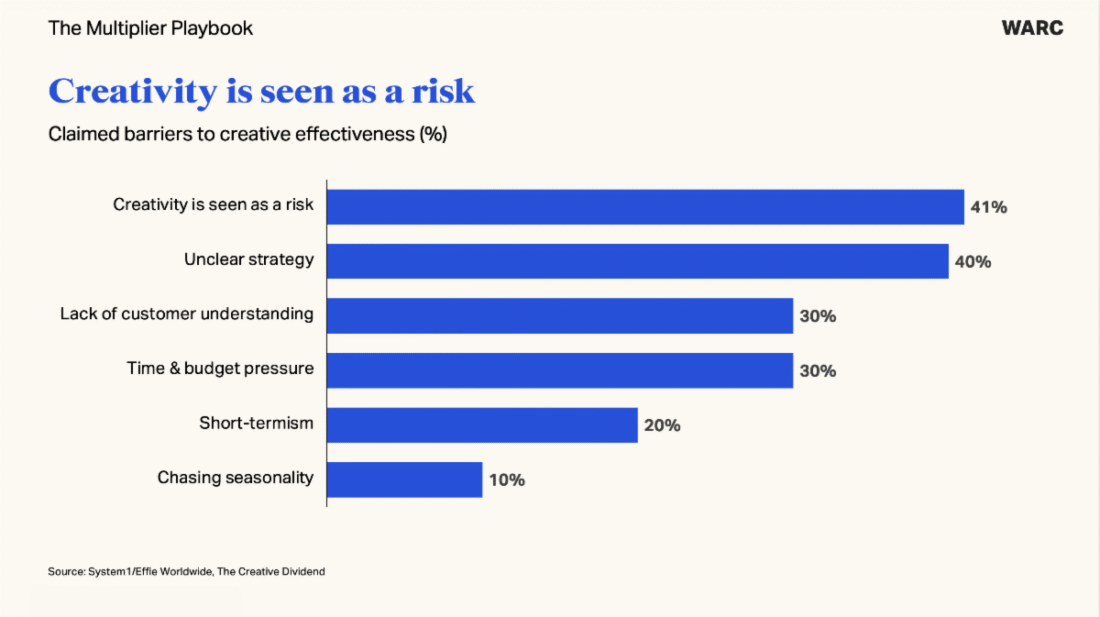
Challenges include a perceived risk of advertising strategies that embrace creativity, cited by 41% of marketers in a System1 and Effie Worldwide survey, and a lack of confidence in advertising effectiveness cited by over half of respondents (52%).
Most ads (90%) are not given time to wear in, according to data from Analytic Partners ROI Genome. Marketers are advised to take a “fewer, bigger, longer” approach to creativity; bring media, creative development and measurement much closer together to achieve the “synergy effects” required in a fragmented, low-attention media landscape; and mitigate the perceived risk of creativity using a four-level “creativity stack”: consistency, showmanship, distinctiveness and emotion.
As previously noted by Mike Cessario, Founder/CEO, Liquid Death, creativity can be especially valuable for smaller brands: “If you’re a small company, it’s literally reckless to be safe. Trying to mimic a big company as a small company is reckless … because we can’t afford to buy the eyeballs like the big guys do.”
The Multiplier Playbook report can be read in full here. An accompanying podcast series, taking a deep dive into the findings of the report, will launch on Thursday, May 21st, with Ann Marie Kerwin, WARC’s Americas Editor, talking to Michael Reh, Head of Data Science and Analytics at BERA.ai, about the business value of brand.
A preview episode, featuring WARC’s David Tiltman and Stephanie Fierman, EVP and head of the Brand Practice at the ANA, was released on Thursday, May 14th.